
Begin with daily life, then follow the biology. This guide connects nutrition, movement, sleep and healthcare with the research questions behind longevity. Read one section at a time, or go directly to the evidence.
Aging does not begin all at once.
There is no birthday on which every biological system switches from young to old. Changes in repair, metabolism and function accumulate across a lifetime, at different rates in different people. Healthy aging also depends on our environment and the support available to us. It is not simply the absence of disease. [1]
A meal. A walk. An opportunity to sleep.
Patterns become easier to maintain, review and adapt.
The aim: preserve health, capacity and meaningful choices.
A perspective on time, not a predicted biological trajectory.
Consistency without perfection
One imperfect meal, missed workout or poor night is not failure. A routine that survives travel, work, illness and changing responsibilities is more useful than an elaborate plan that cannot be maintained. Returning to a workable pattern matters more than trying to compensate with extremes.
Three foundations, continuously connected
Food supports activity and recovery. Resistance exercise and protein work together. Activity can improve sleep, while adequate sleep helps make daily routines manageable. These are interacting foundations, not a sequence to complete. [9] [13]
Selective supplementation may sit alongside these foundations when there is a rational reason. Perfection is not a prerequisite; supplementation is not a replacement.
Nutrition: a pattern, not a perfect meal.
Food quality, sufficient nourishment and a pattern that fits your life deserve more attention than the latest restriction.
Start with what the pattern contains
Cardiovascular dietary guidance emphasizes vegetables, fruit, whole grains, legumes and other appropriate protein sources, with unsaturated plant oils in place of saturated-fat-rich alternatives. Carbohydrate and fat quality matter: beans and whole grains are not nutritionally interchangeable with sugary drinks, even when carbohydrate totals look similar. If you do not drink alcohol, there is no health rationale here to start. [7]
“Processed” is not a useful verdict on its own. Frozen vegetables, canned beans and plain yogurt can make good patterns easier. In a controlled inpatient crossover trial of 20 adults, the ultra-processed menu led to roughly 500 kcal/day greater intake than the unprocessed menu over two-week periods. This supports attention to the food environment; it does not establish that every packaged food has the same effect. [8]
Protein works with a reason to retain muscle
Resistance exercise provides a stimulus; dietary protein supplies amino acids. A meta-analysis of 49 trials found that adding protein improved gains in lean mass and strength during resistance training, with an estimated plateau in additional lean-mass gains around 1.6 g/kg/day of total protein. That is a training-research estimate—not a minimum for every adult or a longevity dose. [9]
Consider the total across food and supplements. Including a protein source at several meals can make an adequate total easier to achieve; this practical approach is not proof of one optimal meal schedule. Age, appetite, energy intake, training and medical conditions change the question. Kidney disease, for example, requires individual nutritional advice.
Fiber: look beyond the carbohydrate total
A major synthesis of cohorts and trials found favorable associations across several health outcomes around 25–29 g/day of dietary fiber, with possible benefits at higher intakes. Trials also supported improvements in some risk markers. This is a population-level reference, not a universal prescription or a guaranteed threshold. [10]
Whole grains, beans, lentils, vegetables, fruit, nuts and seeds provide different food structures as well as fiber. Variety is useful without turning a weekly plant count into a test of success. Increase fiber gradually if needed, with attention to tolerance and any medical dietary restrictions.
Timing can help; it does not override food quality
Time-restricted eating can provide a manageable boundary around eating. In a 12-month trial of 139 adults with obesity, an 8 a.m.–4 p.m. eating window plus calorie restriction did not produce significantly greater weight loss than calorie restriction alone. The result concerns that population and regimen, not every timing strategy. [11]
An eating window that crowds out adequate food, protein or social meals may work against the broader aim. Fasting is not an established human lifespan-extension treatment. It warrants particular caution with glucose-lowering medicines, pregnancy, frailty or a history of eating disorders.
A useful bridge: move after eating
Short, light walking breaks reduced post-meal glucose and insulin responses compared with uninterrupted sitting in a meta-analysis of seven acute crossover studies, largely in adults with overweight or obesity. Walking generally performed better than standing alone. These were short-term metabolic outcomes, not evidence that a particular walking interval extends life. [12]
Practical interpretation: where feasible, let a short walk or movement break follow a meal rather than treating every glucose rise as a problem to eliminate.
Movement: preserve more than one kind of capacity.
Endurance, strength, power and balance answer different questions. A step count cannot describe all of them.
WHO's adult reference for moderate aerobic activity, or 75–150 minutes of vigorous activity, or an equivalent mix. Add muscle-strengthening activity on at least two days. These are population recommendations to work toward—not a starting requirement. Some activity is better than none. [13]
VO₂max: useful capacity, not a lifespan score
VO₂max describes the maximum rate at which the body can use oxygen during intense exercise. VO₂peak is the highest rate observed in a particular test. Both help characterize cardiorespiratory fitness: the integrated ability to deliver and use oxygen.
A 2024 overview of cohort meta-analyses found consistently lower mortality and disease risk among people with higher fitness. Prediction is not the same as a treatment effect: gaining a unit on a watch cannot be translated directly into years of life. Laboratory measures and device estimates are also not interchangeable. [14]
Does everyone need Zone 2?
“Zone 2” is not defined identically across training systems. A 2025 expert commentary placed it just below the first lactate or ventilatory threshold—the point around which breathing and lactate responses begin to change. The authors also noted that expected adaptations may occur at neighboring intensities. This is expert interpretation, not proof of a uniquely superior longevity zone. [15]
Comfortably sustainable aerobic activity is valuable. Brisk walking, cycling or swimming can contribute without laboratory testing. Greater intensity is another option when appropriate, not an obligation to push through symptoms or exhaustion. Choose a mix that can be repeated and recovered from.
Muscle mass, strength and power are not synonyms
- Mass
- How much muscle tissue there is.
- Strength
- How much force you can produce—for example, lifting a load.
- Power
- How quickly force produces movement—for example, getting up from a chair promptly.
Body composition alone misses these differences. Resistance activity, adequate nutrition and recovery belong together. Older adults also benefit from activity emphasizing balance and functional strength; suitable loading and movement variety matter alongside aerobic work. [13] [9]
10,000 steps is not a pass mark
A 2025 review covering 57 prospective studies found favorable associations at step counts below 10,000. For several outcomes, curves changed most around 5,000–7,000 steps/day. Other outcomes showed different patterns. These observational relationships do not prescribe one target for every age or ability. [16]
Use your current activity as a starting point. A modest, sustainable increase can be more useful than chasing a distant round number. Walking totals also miss cycling, swimming and strength work. Break up long periods of sitting rather than assuming one workout describes the whole day. [13] [12]
Sleep: duration, timing and a rhythm you can keep.
The goal is restorative sleep and daytime function, not a flawless score.
The AASM/Sleep Research Society consensus recommends seven or more hours per night for adults aged 18–60. This is not a seven-hour ceiling. Sleep needs vary, and time in bed is not identical to time asleep. [17]
Regularity adds information that duration misses
A study of 60,977 UK Biobank participants linked more regular sleep-wake patterns with lower mortality risk over follow-up. It was observational: illness, work schedules and other factors may influence both regularity and outcomes. It does not show that forcing an exact bedtime extends life. [18]
A reasonably consistent sleep opportunity is a useful aim. It should not mean cutting sleep short simply to maintain a streak. Shift work, caregiving and insomnia call for adaptation, not blame.
Light helps tell the body when it is
The circadian system responds to light reaching the eyes. Expert recommendations favor brighter daytime light, lower evening light and a dark sleep environment. Daylight after waking can be a practical cue for a conventional daytime schedule; timing needs differ for shift workers. This is not a requirement to stare at the sun or purchase a particular device. [19]
Caffeine and alcohol: feeling sleepy is not the same as sleeping well
Caffeine can affect sleep for hours after its alerting effect seems less noticeable. A synthesis of 24 studies found shorter sleep and reduced sleep efficiency after caffeine. Its modeled cutoff of roughly nine hours before bed for a particular coffee dose is an estimate, not a universal deadline. Dose and individual metabolism matter. [20]
Alcohol is not a reliable sleep aid. A 2025 meta-analysis found reduced REM sleep even at lower doses; faster sleep onset was seen mainly at higher doses, alongside greater REM disruption. Sedation and restorative sleep are different outcomes. [21]
Know when the issue is clinical
Persistent difficulty sleeping with daytime impairment deserves assessment. Cognitive behavioral therapy for insomnia (CBT-I) is a recommended treatment for chronic insomnia; generic sleep-hygiene advice alone is not an adequate substitute. Loud snoring, witnessed breathing pauses, gasping or pronounced daytime sleepiness can warrant evaluation for sleep apnea. [22] [23]
A wearable can help describe a pattern for that conversation. Its sleep-stage labels or reassuring score cannot rule out a disorder.
Measure what can improve a decision.
Before collecting another number, ask what you would do differently if it changed. Measurement is useful when it guides a meaningful choice; more measurements do not automatically create better health.
| Finding | What it can tell you | What it does not establish |
|---|---|---|
| A subjective sensation | How you feel: energy, fatigue or sleepiness. | Its cause, or the long-term value of an intervention. |
| A physiological response or biomarker | A response such as heart rate, post-meal glucose or a blood measurement. | That changing it improves health. Some markers predict risk; others have uncertain meaning. |
| A surrogate endpoint | A measure used in place of a clinical outcome, with context-specific supporting evidence. | That every biomarker is a validated surrogate—or that validation transfers to every treatment. |
| A functional outcome | What someone can do: walking, lifting, thinking or managing daily tasks. | Longer survival without follow-up that measures it. |
| A clinical or mortality outcome | Events such as disease, hospitalization or death during a study. | That an observational association is necessarily causal or applies equally to everyone. |
These distinctions are a reading framework, not a ranking that makes symptoms unimportant. Explore how to read evidence →
Wearables: trends over verdicts
Sleep duration estimates, heart-rate trends and activity records may support useful conversations. Consumer sleep technologies have potential, but performance and clinical use depend on the particular device and validation. Do not diagnose a sleep disorder from a generic score or assume that a watch's sleep-stage estimate is equivalent to a sleep study. [24]
For HRV, compare like with like: device, measurement conditions and time of day. A single low value is not a diagnosis or an instruction to add a supplement. Feeling unwell matters even when a dashboard looks reassuring.
CGM without diabetes: a specific question first
Continuous glucose monitoring is established in parts of diabetes care. That does not make it a universal wellness requirement. A 2026 review of 23 studies in people without diabetes found context-dependent benefits, particularly in prediabetes, but no appreciable glycemic benefit in healthy normoglycemic populations. Long-term clinical benefit for routine use in that latter group remains unestablished. [25]
Ask whether the data resolve a real clinical or behavioral question. A flatter glucose curve alone does not establish a healthier overall diet.
Biological-age estimates are not a countdown
Different clocks use different inputs and predict different things. In a post hoc analysis of the two-year CALERIE trial, calorie restriction affected one DNA-methylation measure of aging pace, but did not significantly change several biological-age estimates. The study did not demonstrate longer human lifespan. A favorable test result is a research signal, not proof of rejuvenation. [26]
Interesting practices, proportionate conclusions
- Established foundations
- Regular activity and strength work, sound dietary patterns and adequate sleep have a place in health guidance. This describes their health role, not a promise of a particular lifespan.
- Promising in context
- Meal-timing strategies and selected monitoring approaches may help particular people or outcomes. Feasibility and the population studied determine how useful the findings are.
Heat and cold are physiological stresses, not prerequisites for healthy aging. Enjoyment, suitability and safety matter more than enduring a more extreme exposure.
From daily function to the cell.
Biology gives us a vocabulary for asking better questions. The hallmarks of aging connect changes in DNA, proteins, cellular renewal, nutrient sensing, mitochondria, inflammation and communication. They form a research framework—not a checklist of supplements or a diagnosis of aging as a disease. [2]
Mitochondria: one important part of the system
Mitochondria help convert energy from nutrients into ATP, a molecule used to couple many cellular reactions. They also participate in metabolic signaling, calcium regulation and cellular responses to stress. A change in mitochondrial biology is not automatically a change in physical function. [3]
CELL → MITOCHONDRION → INNER MEMBRANE → ATP
A closer look at cellular energy.
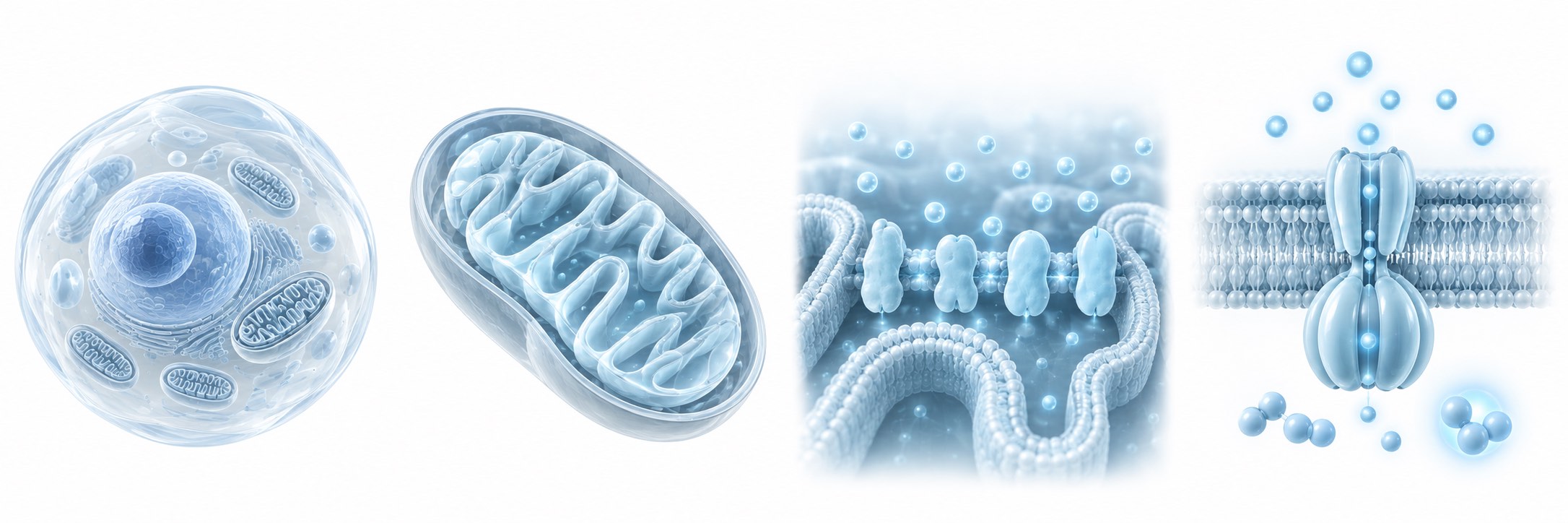
Cell
Many cells contain mitochondria, alongside a nucleus and other specialized structures.
Mitochondrion
A double-membrane organelle. The inner membrane folds into cristae, providing space for energy-converting machinery.
Inner membrane
Electron transfer through the respiratory chain powers proton pumping from the matrix, building an electrochemical gradient.
ATP production
Protons return through ATP synthase. This drives the formation of ATP from ADP and phosphate (Pᵢ).
Nutrient-derived electrons → proton gradient → ATP synthesis
Oxygen accepts electrons at the end of the respiratory chain. Simplified schematic; not to scale. The arrows above show linked processes, not one particle's path. [4]
Maintenance matters alongside production
Biogenesis builds components; fusion and fission reorganize mitochondrial networks; mitophagy helps remove mitochondria through selective degradation. These are connected processes, not interchangeable synonyms for “more energy.” More of one marker is not necessarily better overall function. [3]
Mitochondria also do not replace the rest of longevity biology. Protein quality control, tissue renewal, immunity and the body's environment remain part of the picture. Mechanisms help identify what to measure; human studies determine what an intervention actually changes. [2]
Health also depends on care.
Nutrition, movement and sleep are not the entirety of prevention. Tobacco avoidance, appropriate assessment of cardiovascular and metabolic risk, vaccination and screening belong in the broader picture. So do oral health, hearing, vision, mental health and social connection. What is appropriate depends on age, history and local guidance—not on a universal longevity test panel. [1] [5]
Medical care and lifestyle can support each other. Neither a supplement stack nor a reassuring wearable score should postpone assessment of symptoms.
Supplementation alongside real life.
You do not need perfect nutrition, exercise or sleep before considering a supplement. There should, however, be a reason: an identified need, a relevant evidence base, or a clearly explained design rationale. More ingredients do not automatically mean more benefit, and overlapping products can increase total exposure. [6]
- Why this ingredient—and for whom?
- Why this amount and form?
- What does the human evidence show?
- What is known about safety and interactions?
- What remains uncertain?
- How are identity, purity and quality verified?
- Does repeated use make sense?
Study duration matters. A short trial cannot establish safety over years, and evidence for individual ingredients does not establish the effects of their combination. Read about supplement safety →
LÍFSVARÐA / A LONGER DESIGN HORIZON
Why we do not begin with “feel the effect.”
A long-term perspective connects everyday habits with research on ageing. A plausible design or biological mechanism alone does not demonstrate long-term safety or lifespan extension.
Not every biologically relevant process produces a noticeable sensation. Equally, feeling something does not by itself establish long-term value. Subjective experience still matters—especially unexpected symptoms or adverse reactions, which should never be ignored. Stop use and seek appropriate advice if a suspected adverse reaction occurs.
The better starting question is: Does the evidence justify this choice, over the time I intend to use it?
Evidence behind the framework.
This is an editorial synthesis, not a systematic review. Sources were selected for the question they answer: guidance for foundations, human trials and reviews for interventions, cohorts for long-term associations, and biological reviews for mechanisms. “Established,” “promising” and “uncertain” refer to the stated question, not a universal grade for a practice.
Research summaries below identify what was checked and what each source can support. Funding and conflicts are reported only where verified; an unverified disclosure is not a claim that none exists.
WHO — Healthy ageing and functional ability
Guidance / public information — Functional ability reflects personal capacity and environment. Healthy aging does not require complete absence of disease.
Review scope, funding & conflicts
Official guidance page reviewed
Funding: Not separately assessed
Conflicts of interest: Not separately assessed
Hallmarks of aging: An expanding universe.
López-Otín C, Blasco MA, Partridge L, Serrano M, Kroemer G. · Cell · 2023 DOI
Biological review / research framework — Interconnected aging mechanisms; not evidence that targeting each one extends human lifespan.
Review scope, funding & conflicts
Bibliographic record and abstract reviewed via Europe PMC / PubMed on 2026-09-26; full text not assessed
Funding: Not verified in the reviewed abstract
Conflicts of interest: Not verified in the reviewed abstract
Mitochondria in health, disease, and aging.
Harrington JS, Ryter SW, Plataki M, Price DR, Choi AMK. · Physiological reviews · 2023 DOI
Biological review — Mitochondrial ATP production, signaling and maintenance. Biological roles do not establish oral-supplement efficacy.
Review scope, funding & conflicts
Bibliographic record and abstract reviewed via Europe PMC / PubMed on 2026-09-26; full text not assessed
Funding: Not verified in the reviewed abstract
Conflicts of interest: Not verified in the reviewed abstract
Alberts et al. — Electron-Transport Chains and Their Proton Pumps
Guidance / public information — Mechanism supporting the simplified energy diagram. The drawing is original and not a reproduction.
Review scope, funding & conflicts
Existing source record retained; current full chapter access unavailable. Mechanism also cross-checked against the mitochondrial review.
Funding: Not separately assessed
Conflicts of interest: Not separately assessed
National Institute on Aging — Health topics
Guidance / public information — Official routes to preventive care, hearing, vision, mental health and vaccination information. Local clinical guidance determines individual care.
Review scope, funding & conflicts
Official topic index and search excerpts; not a review of every linked recommendation
Funding: Not separately assessed
Conflicts of interest: Not separately assessed
NCCIH — Using Dietary Supplements Wisely
Guidance / public information — Safety, interactions and the need to assess supplements in the context of medicines and healthcare.
Review scope, funding & conflicts
Official guidance page reviewed
Funding: Not separately assessed
Conflicts of interest: Not separately assessed
2021 Dietary Guidance to Improve Cardiovascular Health: A Scientific Statement From the American Heart Association.
Lichtenstein AH, Appel LJ, Vadiveloo M, Hu FB, Kris-Etherton PM, Rebholz CM, Sacks FM, Thorndike AN, Van Horn L, Wylie-Rosett J. · Circulation · 2021 DOI
AHA scientific statement — Dietary patterns, food quality, appropriate energy intake and the context of food access. Not an individualized diet prescription.
Review scope, funding & conflicts
Bibliographic record and abstract reviewed via Europe PMC / PubMed on 2026-09-26; full text not assessed
Funding: Not verified in the reviewed abstract
Conflicts of interest: Not verified in the reviewed abstract
Ultra-Processed Diets Cause Excess Calorie Intake and Weight Gain: An Inpatient Randomized Controlled Trial of Ad Libitum Food Intake.
Hall KD, Ayuketah A, Brychta R, Cai H, Cassimatis T, Chen KY, Chung ST, Costa E, Courville A, Darcey V, Fletcher LA, Forde CG, Gharib AM, Guo J, Howard R, Joseph PV, McGehee S, Ouwerkerk R, Raisinger K, Rozga I, Stagliano M, Walter M, Walter PJ, Yang S, Zhou M. · Cell metabolism · 2019 DOI
Randomized inpatient crossover trial — 20 adults; two weeks per diet. Ultra-processed menus increased energy intake by about 508 kcal/day. Short controlled feeding periods cannot represent every food or long-term setting.
Review scope, funding & conflicts
Bibliographic record and abstract reviewed via Europe PMC / PubMed on 2026-09-26; full text not assessed
Funding: Not verified in the reviewed abstract
Conflicts of interest: Not verified in the reviewed abstract
A systematic review, meta-analysis and meta-regression of the effect of protein supplementation on resistance training-induced gains in muscle mass and strength in healthy adults.
Morton RW, Murphy KT, McKellar SR, Schoenfeld BJ, Henselmans M, Helms E, Aragon AA, Devries MC, Banfield L, Krieger JW, Phillips SM. · British journal of sports medicine · 2018 DOI
Systematic review and meta-analysis of randomized trials — 49 trials; 1,863 participants; resistance training for at least six weeks. Protein supplementation modestly augmented gains. The estimated total-intake plateau near 1.6 g/kg/day concerns lean-mass gains during training, not lifespan.
Review scope, funding & conflicts
Bibliographic record and abstract reviewed via Europe PMC / PubMed on 2026-09-26; full text not assessed
Funding: Not verified in the reviewed abstract
Conflicts of interest: Not verified in the reviewed abstract
Carbohydrate quality and human health: a series of systematic reviews and meta-analyses.
Reynolds A, Mann J, Cummings J, Winter N, Mete E, Te Morenga L. · Lancet (London, England) · 2019 DOI
Systematic reviews of cohorts and trials — 185 prospective studies and 58 trials. Higher fiber intake was associated with better clinical outcomes; trials supported improvements in some risk markers. The 25–29 g/day range is population evidence.
Review scope, funding & conflicts
Bibliographic record and abstract reviewed via Europe PMC / PubMed on 2026-09-26; full text not assessed
Funding: Health Research Council of New Zealand, WHO, Riddet Centre, Healthier Lives National Science Challenge, University of Otago and Otago Southland Diabetes Research Trust (abstract)
Conflicts of interest: Not verified in the reviewed abstract
Calorie Restriction with or without Time-Restricted Eating in Weight Loss.
Liu D, Huang Y, Huang C, Yang S, Wei X, Zhang P, Guo D, Lin J, Xu B, Li C, He H, He J, Liu S, Shi L, Xue Y, Zhang H. · The New England journal of medicine · 2022 DOI
Randomized controlled trial — 139 adults with obesity; 12 months. An early eight-hour eating window plus calorie restriction did not significantly outperform calorie restriction alone for weight loss.
Review scope, funding & conflicts
Bibliographic record and abstract reviewed via Europe PMC / PubMed on 2026-09-26; full text not assessed
Funding: National Key Research and Development Project and others; abstract does not list all support
Conflicts of interest: Not verified in the reviewed abstract
The Acute Effects of Interrupting Prolonged Sitting Time in Adults with Standing and Light-Intensity Walking on Biomarkers of Cardiometabolic Health in Adults: A Systematic Review and Meta-analysis.
Buffey AJ, Herring MP, Langley CK, Donnelly AE, Carson BP. · Sports medicine (Auckland, N.Z.) · 2022 DOI
Meta-analysis of acute randomized crossover trials — Seven one-day trials, largely in adults with overweight or obesity. Light walking breaks lowered postprandial glucose and insulin compared with continued sitting. Long-term outcomes were not tested.
Review scope, funding & conflicts
Bibliographic record and abstract reviewed via Europe PMC / PubMed on 2026-09-26; full text not assessed
Funding: Not verified in the reviewed abstract
Conflicts of interest: Not verified in the reviewed abstract
WHO — Guidelines on physical activity and sedentary behaviour
Guidance / public information — Adult aerobic activity ranges, strengthening, less sedentary time and balance-oriented activity for older adults. Adapt participation to capacity and health.
Review scope, funding & conflicts
Official guideline summary and physical-activity fact sheet reviewed
Funding: Not separately assessed
Conflicts of interest: Not separately assessed
Cardiorespiratory fitness is a strong and consistent predictor of morbidity and mortality among adults: an overview of meta-analyses representing over 20.9 million observations from 199 unique cohort studies.
Lang JJ, Prince SA, Merucci K, Cadenas-Sanchez C, Chaput JP, Fraser BJ, Manyanga T, McGrath R, Ortega FB, Singh B, Tomkinson GR. · British journal of sports medicine · 2024 DOI
Overview of cohort meta-analyses — Higher cardiorespiratory fitness consistently predicted lower morbidity and mortality. Evidence certainty ranged from very low to moderate; predictive associations are not individual treatment effects.
Review scope, funding & conflicts
Bibliographic record and abstract reviewed via Europe PMC / PubMed on 2026-09-26; full text not assessed
Funding: Not verified in the reviewed abstract
Conflicts of interest: Not verified in the reviewed abstract
What Is "Zone 2 Training"?: Experts' Viewpoint on Definition, Training Methods, and Expected Adaptations.
Sitko S, Artetxe X, Bonnevie-Svendsen M, Galán-Rioja MÁ, Gallo G, Grappe F, Leo P, Mateo M, Mujika I, Sanders D, Seiler S, Zabala M, Valenzuela PL, Viribay A. · International journal of sports physiology and performance · 2025 DOI
Expert commentary — Panel of 14 scientists and coaches; proposed a definition just below the first lactate or ventilatory threshold. Expected adaptations are not necessarily unique to Zone 2.
Review scope, funding & conflicts
Bibliographic record and abstract reviewed via Europe PMC / PubMed on 2026-09-26; full text not assessed
Funding: Not verified in the reviewed abstract
Conflicts of interest: Not verified in the reviewed abstract
Daily steps and health outcomes in adults: a systematic review and dose-response meta-analysis.
Ding D, Nguyen B, Nau T, Luo M, Del Pozo Cruz B, Dempsey PC, Munn Z, Jefferis BJ, Sherrington C, Calleja EA, Hau Chong K, Davis R, Francois ME, Tiedemann A, Biddle SJH, Okely A, Bauman A, Ekelund U, Clare P, Owen K. · The Lancet. Public health · 2025 DOI
Systematic review and dose-response meta-analysis of prospective studies — 57 studies from 35 cohorts in the review. Favorable associations below 10,000 steps; several curves had inflection points around 5,000–7,000. Residual confounding and limited age-specific analysis remain.
Review scope, funding & conflicts
Bibliographic record and abstract reviewed via Europe PMC / PubMed on 2026-09-26; full text not assessed
Funding: National Health and Medical Research Council, New South Wales Health and Ian Potter Foundation (abstract)
Conflicts of interest: Not verified in the reviewed abstract
AASM / Sleep Research Society — Recommended amount of adult sleep
Guidance / public information — Consensus recommendation of seven or more hours regularly for adults aged 18–60; not a precise individual optimum.
Review scope, funding & conflicts
Official guidance page reviewed
Funding: Not separately assessed
Conflicts of interest: Not separately assessed
Sleep regularity is a stronger predictor of mortality risk than sleep duration: A prospective cohort study.
Windred DP, Burns AC, Lane JM, Saxena R, Rutter MK, Cain SW, Phillips AJK. · Sleep · 2024 DOI
Prospective cohort — 60,977 UK Biobank participants; mean follow-up about 6.3 years. More regular sleep was associated with lower mortality. Residual confounding prevents a causal interpretation.
Review scope, funding & conflicts
Bibliographic record and abstract reviewed via Europe PMC / PubMed on 2026-09-26; full text not assessed
Funding: Not verified in the reviewed abstract
Conflicts of interest: Not verified in the reviewed abstract
Recommendations for daytime, evening, and nighttime indoor light exposure to best support physiology, sleep, and wakefulness in healthy adults.
Brown TM, Brainard GC, Cajochen C, Czeisler CA, Hanifin JP, Lockley SW, Lucas RJ, Münch M, O'Hagan JB, Peirson SN, Price LLA, Roenneberg T, Schlangen LJM, Skene DJ, Spitschan M, Vetter C, Zee PC, Wright KP. · PLoS biology · 2022 DOI
Expert scientific consensus — Light exposure is relevant to circadian, alerting and sleep responses. Recommendations address light timing and intensity, not proof of lifespan extension.
Review scope, funding & conflicts
Bibliographic record and abstract reviewed via Europe PMC / PubMed on 2026-09-26; full text not assessed
Funding: Not verified in the reviewed abstract
Conflicts of interest: Not verified in the reviewed abstract
The effect of caffeine on subsequent sleep: A systematic review and meta-analysis.
Gardiner C, Weakley J, Burke LM, Roach GD, Sargent C, Maniar N, Townshend A, Halson SL. · Sleep medicine reviews · 2023 DOI
Systematic review and meta-analysis — 24 studies. Caffeine reduced sleep duration and efficiency on average. Dose-dependent modeled timing estimates should not be treated as a universal cutoff.
Review scope, funding & conflicts
Bibliographic record and abstract reviewed via Europe PMC / PubMed on 2026-09-26; full text not assessed
Funding: Not verified in the reviewed abstract
Conflicts of interest: Not verified in the reviewed abstract
The effect of alcohol on subsequent sleep in healthy adults: A systematic review and meta-analysis.
Gardiner C, Weakley J, Burke LM, Roach GD, Sargent C, Maniar N, Huynh M, Miller DJ, Townshend A, Halson SL. · Sleep medicine reviews · 2025 DOI
Systematic review and meta-analysis — 27 studies. REM sleep was disrupted even at lower doses; shorter sleep-onset latency was chiefly seen at high doses. Effects on some other sleep measures were uncertain.
Review scope, funding & conflicts
Bibliographic record and abstract reviewed via Europe PMC / PubMed on 2026-09-26; full text not assessed
Funding: Not verified in the reviewed abstract
Conflicts of interest: Not verified in the reviewed abstract
AASM — Behavioral and psychological treatments for insomnia
Guidance / public information — CBT-I is recommended for chronic insomnia. Sleep hygiene alone is not recommended as a stand-alone treatment.
Review scope, funding & conflicts
Official guidance page reviewed
Funding: Not separately assessed
Conflicts of interest: Not separately assessed
NHLBI — Sleep apnea symptoms
Guidance / public information — Breathing interruptions, gasping, snoring and daytime symptoms can warrant clinical evaluation.
Review scope, funding & conflicts
Official guidance page reviewed
Funding: Not separately assessed
Conflicts of interest: Not separately assessed
Consumer Sleep Technology: An American Academy of Sleep Medicine Position Statement.
Khosla S, Deak MC, Gault D, Goldstein CA, Hwang D, Kwon Y, O'Hearn D, Schutte-Rodin S, Yurcheshen M, Rosen IM, Kirsch DB, Chervin RD, Carden KA, Ramar K, Aurora RN, Kristo DA, Malhotra RK, Martin JL, Olson EJ, Rosen CL, Rowley JA, American Academy of Sleep Medicine Board of Directors. · Journal of clinical sleep medicine : JCSM : official publication of the American Academy of Sleep Medicine · 2018 DOI
AASM position statement (2018) — Clinical use requires validation and appropriate evaluation. This historical statement does not establish the performance or regulatory status of current individual devices.
Review scope, funding & conflicts
Bibliographic record and abstract reviewed via Europe PMC / PubMed on 2026-09-26; full text not assessed
Funding: Not verified in the reviewed abstract
Conflicts of interest: Not verified in the reviewed abstract
Continuous glucose monitoring in non-diabetic populations: a systematic review of observational and interventional studies with meta-analysis.
Liao X, Li Y, Tang S, Xiao Y, Yu X, Huang R, Zhong T. · European journal of medical research · 2026 DOI
Systematic review and meta-analysis — 23 mixed-design studies; 1,074 participants without diabetes. Some glycemic and behavioral signals, especially in prediabetes, but no appreciable benefit in healthy normoglycemic groups. Not a long-term clinical-outcome trial.
Review scope, funding & conflicts
Bibliographic record and abstract reviewed via Europe PMC / PubMed on 2026-09-26; full text not assessed
Funding: Not verified in the reviewed abstract
Conflicts of interest: Not verified in the reviewed abstract
Effect of long-term caloric restriction on DNA methylation measures of biological aging in healthy adults from the CALERIE trial.
Waziry R, Ryan CP, Corcoran DL, Huffman KM, Kobor MS, Kothari M, Graf GH, Kraus VB, Kraus WE, Lin DTS, Pieper CF, Ramaker ME, Bhapkar M, Das SK, Ferrucci L, Hastings WJ, Kebbe M, Parker DC, Racette SB, Shalev I, Schilling B, Belsky DW. · Nature aging · 2023 DOI
Post hoc analysis of a randomized trial — Two-year CALERIE trial in adults without obesity. One methylation-based pace measure changed; several age estimates did not. Effects on disease incidence or mortality were not established.
Review scope, funding & conflicts
Bibliographic record and abstract reviewed via Europe PMC / PubMed on 2026-09-26; full text not assessed
Funding: Not verified in the reviewed abstract
Conflicts of interest: Not verified in the reviewed abstract
Association between sauna bathing and fatal cardiovascular and all-cause mortality events.
Laukkanen T, Khan H, Zaccardi F, Laukkanen JA. · JAMA internal medicine · 2015 DOI
Prospective cohort — 2,315 Finnish men aged 42–60 at baseline; median follow-up 20.7 years. Sauna frequency was associated with mortality outcomes; causality and generalizability remain unresolved.
Review scope, funding & conflicts
Bibliographic record and abstract reviewed via Europe PMC / PubMed on 2026-09-26; full text not assessed
Funding: Not verified in the reviewed abstract
Conflicts of interest: Not verified in the reviewed abstract
Effects of cold-water immersion on health and wellbeing: A systematic review and meta-analysis.
Cain T, Brinsley J, Bennett H, Nelson M, Maher C, Singh B. · PloS one · 2025 DOI
Systematic review and meta-analysis of randomized trials — 11 studies. Time-dependent signals for stress and wellbeing, with limited and heterogeneous evidence. Does not establish a lifespan benefit.
Review scope, funding & conflicts
Bibliographic record and abstract reviewed via Europe PMC / PubMed on 2026-09-26; full text not assessed
Funding: Not verified in the reviewed abstract
Conflicts of interest: Not verified in the reviewed abstract
CITE THIS PAGE
LÍFSVARÐA. Built over time: the foundations of longevity. English edition, version 4.0. Reviewed 26 September 2026.
https://lifsvarda.com/knowledge/healthy-ageing/Edited by LÍFSVARÐA, a supplement brand. Scientific evidence and brand design intentions are distinguished. Editorial policy. Updated 26 September 2026: expanded nutrition, movement, sleep and measurement; simplified the mitochondrial diagram. This English edition has been developed independently of the Japanese edition.